

To handle language barriers without feeling embarrassed, focus on staying calm and confident. Use simple language, speak slowly, and incorporate gestures or visuals to clarify your message. Confirm understanding by asking questions and paraphrasing. Remember to listen actively and remain patient with yourself. Utilize translation apps or tools to bridge gaps, and don’t hesitate to seek shared experiences for connection. Keep confidence high—if you continue exploring, you’ll discover more effective strategies to communicate smoothly.

Get travel and outdoor gear delivered free with Prime
- Fast, free delivery on millions of items
- Prime Video, Amazon Music and more included
- Member-only deals all year
Key Takeaways
- Use simple, clear language and avoid jargon to minimize misunderstandings.
- Incorporate visual aids, gestures, and facial expressions to support your message.
- Pause regularly to check understanding and rephrase key points for clarity.
- Practice mindfulness and positive affirmations to stay confident and reduce anxiety.
- Utilize translation apps and language resources to assist communication and build confidence.
As an affiliate, we earn on qualifying purchases.
What Causes Language Barriers and How Can You Overcome Them?

Have you ever wondered what causes language barriers and how you can break through them? Often, language differences are at the core, making it hard to understand each other clearly. When people speak different languages or dialects, miscommunication naturally occurs. Cultural misunderstandings also play a big role—they influence how messages are delivered and received. For example, gestures or expressions meaningful in one culture might be confusing or offensive in another. These factors create obstacles that hinder effective communication. To overcome them, recognizing that language differences and cultural misunderstandings are common is key. Being patient, open-minded, and willing to learn about others’ backgrounds can help you navigate these barriers. Additionally, understanding the roots of communication issues can help you develop practical strategies for better interaction. For instance, being aware of cultural communication styles can significantly improve your conversations. Ultimately, understanding the roots of these issues allows you to find practical ways to communicate better.
As an affiliate, we earn on qualifying purchases.
How to Communicate Clearly and Simply to Avoid Confusion

To communicate clearly and avoid confusion, use simple language everyone can understand. Speak slowly and clearly so your message isn’t lost or misunderstood. Make sure to check in regularly and confirm that your listener has understood what you’re saying. Paying attention to color accuracy ensures your messages are conveyed accurately through visuals. Additionally, being aware of visual clarity helps prevent misunderstandings caused by unclear or confusing visuals. Being mindful of your electric bike speed can also help set appropriate expectations for your audience. Regularly updating your knowledge about Glycolic Acid benefits can help you better explain skincare concepts and avoid misconceptions. Incorporating accurate performance parts terminology can further improve your clarity when discussing technical details.
Use Simple Language
Ever wonder why some conversations lead to confusion while others go smoothly? The key is using simple language. When you keep your words straightforward, it’s easier for others to understand, especially during language learning or when cultural awareness varies. Avoid complex phrases or idioms that might not translate well. Instead, focus on clear, direct sentences. This approach enhances media literacy by helping you communicate more effectively and avoid misinterpretations. Using colloquial expressions can sometimes cause misunderstandings, so steering clear of them supports clarity. Clear and direct communication also demonstrates respect for the other person’s language skills and encourages mutual understanding. This reduces misunderstandings and builds confidence in your communication. Simple language also shows respect for the other person’s language skills and helps create a comfortable atmosphere. Remember, clarity beats complexity. By choosing easy-to-understand words, you make conversations more effective and less stressful, helping both parties feel heard and understood. Incorporating clear communication techniques such as avoiding jargon further supports understanding. Simple language is your best tool for steering through language barriers with ease.
Speak Slowly and Clearly
Wondering how to make your messages clearer? Speaking slowly and clearly helps prevent misunderstandings. To improve your communication, focus on these key tips:
- Practice pronunciation regularly to guarantee your words are understood.
- Use simple sentences and pause between ideas to give others time to process.
- Build your vocabulary so you can express yourself more precisely, reducing confusion.
- Remember that effective communication is essential for overcoming language barriers and ensuring your message gets across accurately.
- Incorporate clear speech techniques such as enunciating each word carefully and maintaining a steady pace to enhance understanding.
Confirm Understanding Regularly
Since misunderstandings can easily happen when communicating across language barriers, it’s important to verify that your message has been understood. Cultural differences can affect how people interpret what you say, so checking in ensures clarity. During conversations, pause regularly to ask if the other person understands or if they need clarification. This approach demonstrates your consideration for cultural differences and helps prevent miscommunication. Using visual aids or gestures can also enhance understanding, especially when language skills are limited. Employing proper dilution ratios in your explanations about paint preparation can clarify technical details and prevent errors. Clear communication can also be supported by understanding effective personal finance planning strategies, which emphasize clarity and goal orientation in all exchanges. Use simple language and avoid jargon to make it easier for them to follow along. Rephrasing key points can also help confirm understanding. Incorporating progress reviews into your communication can help identify and address ongoing misunderstandings early. Remember, confirming understanding isn’t about doubting your message but about bridging gaps in communication. By making this a habit, you’ll reduce confusion and foster smoother, more confident interactions across language barriers.
As an affiliate, we earn on qualifying purchases.
Using Non-Verbal Cues and Visuals to Support Your Message

When language barriers exist, non-verbal cues and visuals can bridge the communication gap effectively. Gestural communication plays a key role, helping you emphasize points and clarify meaning without words. Visual aids, like pictures or diagrams, support your message and make complex ideas easier to understand. To maximize their effectiveness: 1. Use expressive gestures to reinforce your words and convey emotions. 2. Incorporate visual aids that are simple, clear, and relevant to your message. 3. Maintain eye contact and use facial expressions to demonstrate engagement and understanding. 4. Remember that aquatic exercise and other water-based activities can serve as alternative ways to connect and communicate through shared experiences. Additionally, understanding the importance of communication strategies can enhance your ability to overcome language differences effectively. Recognizing the role of cybersecurity measures, especially in digital communication, can also protect your interactions from potential threats. Being aware of cabling solutions and how they can be used to facilitate clear visual communication in presentations or meetings adds another valuable layer. These strategies help your audience grasp your message quickly and reduce misunderstandings. By leveraging non-verbal cues and visual support, you can navigate language differences with confidence and ensure your communication remains effective. Incorporating non-verbal communication techniques can further improve your interactions and foster better understanding.
portable language translator device
As an affiliate, we earn on qualifying purchases.
As an affiliate, we earn on qualifying purchases.
Listening Actively and Confirming Understanding to Prevent Miscommunication

To prevent miscommunication, focus on clarifying key points and paraphrasing what you hear. Using visual cues can also reinforce understanding during conversations. These strategies help make certain everyone stays on the same page despite language differences. Additionally, practicing active listening can help you better interpret nuances and reduce misunderstandings effective communication techniques. Engaging in language nuance awareness can further enhance your ability to navigate subtle contextual cues. Recognizing cultural support breakfast traditions can also provide helpful context during conversations. Incorporating herbal baths and spices into daily routines may create a calming environment that encourages open dialogue and patience during language exchanges.
Clarify Key Points
Have you ever misunderstood someone’s message because you didn’t clarify key points? Cultural differences and varying language proficiency can make it easy to miss important details. To prevent this, focus on actively listening and confirming understanding. Here are three ways to clarify key points:
- Ask specific questions about unclear parts to ensure your understanding matches their intent.
- Summarize what you’ve heard in your own words, which helps identify any misinterpretations.
- Encourage the speaker to repeat or rephrase critical information if you’re unsure.
These steps help bridge language gaps and account for cultural differences. By clarifying key points, you reduce miscommunication and build confidence in your interactions despite language barriers.
Paraphrase for Confirmation
Ever wondered how to make sure you truly understand someone’s message during a conversation? Using paraphrasing techniques helps confirm your understanding and shows you’re actively listening. When you restate what you’ve heard in your own words, you give the speaker a chance to clarify if needed. Confirmation strategies like saying, “So, what you’re saying is…” or “If I grasp correctly, you mean…” help prevent miscommunication. These techniques encourage open dialogue and reduce misunderstandings, especially in language barriers. Keep your paraphrases simple and focused on key points. By actively listening and confirming your understanding, you build trust and ensure both of you are on the same page. This approach makes conversations smoother and more effective, even when language differences exist.
Use Visual Cues
Using visual cues during conversations enhances your ability to listen actively and confirm understanding. Gestural communication and facial expressions provide valuable context when language barriers exist. To effectively use visual cues, consider these steps:
- Observe facial expressions to gauge emotions and reactions.
- Use gestures to emphasize key points or clarify meaning.
- Confirm understanding by nodding or giving visual feedback, like a thumbs-up.
Pay attention to how the other person’s facial expressions shift, signaling whether they understand or need further explanation. Incorporating these cues helps prevent miscommunication and shows your engagement. Remember, non-verbal signals often speak louder than words, especially across language differences. By actively observing and responding to visual cues, you foster clearer, more confident interactions.
Staying Calm and Confident When Facing Language Challenges

When faced with language barriers, it’s natural to feel nervous or self-conscious, but maintaining your composure is key. Practice mindfulness exercises to stay present and centered, helping reduce anxiety. Take deep breaths to calm your mind and body, allowing you to respond thoughtfully instead of reacting out of stress. Positive affirmations can boost your confidence; remind yourself that making mistakes is normal and that your efforts are valuable. Visualize successful interactions and focus on your intention to communicate clearly. Remember, staying calm isn’t about perfection but about showing patience and resilience. With regular practice, you’ll find it easier to keep your nerves at bay and approach language challenges with confidence and a positive mindset.
Essential Tools and Resources to Help You Bridge Language Gaps
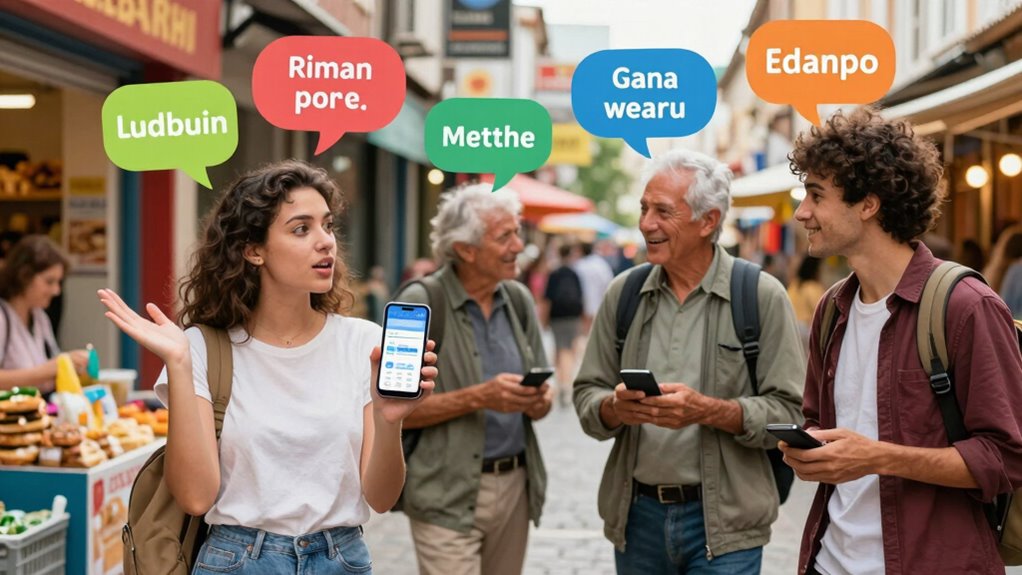
What are the essential tools and resources that can help you effectively bridge language gaps? First, translation apps are invaluable. They instantly convert speech or text, making communication smoother. Second, participating in language exchange programs allows you to practice conversational skills with native speakers, building confidence and understanding. Third, online platforms and forums provide access to language learning resources, tutorials, and cultural insights that deepen your grasp of unfamiliar languages. Combining these tools ensures you’re prepared to navigate diverse situations, whether traveling, working, or socializing. Using translation apps alongside real-world practice through language exchange helps you overcome embarrassment and communicate more naturally. Embracing these resources empowers you to handle language barriers with confidence and ease.
Frequently Asked Questions
How Can I Improve My Language Skills Quickly in a New Environment?
To improve your language skills quickly, engage in language exchange partners regularly. Practice speaking with native speakers, and don’t be afraid to make mistakes. Use immersion techniques like watching local shows, listening to music, and reading in the new language. These activities help you learn naturally and boost confidence. Consistent practice, combined with real-world conversations, accelerates your progress and helps you feel more comfortable in your new environment.
What Should I Do if I Make Mistakes While Speaking?
Imagine your words as delicate glassware—mistakes happen, but they’re part of learning. When you slip up, apologize sincerely and keep going. Remember, practicing active listening helps you understand better and reduces errors. Don’t let fear of mistakes block your progress; each one is a stepping stone. Embrace them as opportunities to improve, showing humility and confidence. Your efforts will turn missteps into mastery over time.
Are There Cultural Differences I Should Be Aware of During Communication?
You should be aware of cultural etiquette and communication norms to avoid misunderstandings. Respect local customs, like greetings or gestures, and listen carefully to social cues. Avoid assumptions and ask polite questions if you’re unsure about proper behavior. Being open-minded and adaptable helps you connect better. Remember, showing genuine interest and respect for different cultural practices builds trust and makes communication smoother, even when language barriers exist.
How Can Technology Assist in Overcoming Language Barriers Effectively?
Did you know over 80% of travelers rely on translation apps? These tools make overcoming language barriers easier by providing instant translations, helping you communicate confidently. Language learning platforms can also boost your skills over time, reducing reliance on apps. Use translation apps for quick help and invest in language learning platforms to build long-term confidence. Technology empowers you to connect more deeply without feeling embarrassed.
What Strategies Can I Use to Build Confidence in Unfamiliar Language Settings?
To build confidence in unfamiliar language settings, start with practical exercises like repeating common phrases or practicing dialogues. Use confidence-building techniques such as positive self-talk and focusing on progress rather than perfection. Engage actively by asking questions and listening carefully. Remember, making mistakes is part of learning. Consistent practice and celebrating small victories will help you feel more comfortable and confident in any new language environment.
Conclusion
Remember, traversing language barriers is like crossing a busy street—your confidence and patience help you find the right path. I once struggled to order food abroad, but by using simple words and gestures, I managed a smile and a meal. Overcoming these challenges isn’t about perfection; it’s about connection. With the right tools and mindset, you’ll build bridges where words might fall short, turning confusion into clarity and embarrassment into confidence.
Halloween Picks
halloween
As an affiliate, we earn on qualifying purchases.