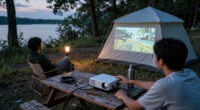
Choosing a portable outdoor projector means balancing the convenience of a self-contained setup against the brightness needed to make a large picture watchable outside. LED portable outdoor projectors tend to cost less and suit casual, battery-powered viewing. Laser portable outdoor projectors usually cost more but can produce a brighter, more vivid image, which helps when the screen is larger or the surroundings are not fully dark.

Get travel and outdoor gear delivered free with Prime
- Fast, free delivery on millions of items
- Prime Video, Amazon Music and more included
- Member-only deals all year

Aurzen Roku TV D1R Smart Portable Outdoor Projector with WiFi and Bluetooth
- ✔ Native resolution: 1920 × 1080
- ✔ Display type: LCD
- ✔ Brightness: 300 ANSI lumens

Aurzen D1R Air USB-C Powered Smart Portable Roku TV Projector
- ✔ Native resolution: 1080p
- ✔ Brightness: 300 ANSI lumens
- ✔ Weight: 1.18 kg

HAPPRUN Native 1080P Bluetooth Projector – Standard
- ✔ Native resolution: 1920 × 1080
- ✔ Display type: LCD
- ✔ Brightness: 300 ANSI lumens
The difference matters most in the setting you plan to use: a small screen after sunset favors the simpler value of LED, while a larger image or lingering ambient light makes laser’s extra brightness more useful. Neither label guarantees a built-in battery, weather resistance, or a particular image quality, so compare those specifications on the actual models. This guide compares the two technologies across the decisions that shape outdoor use.
At a Glance
| Criteria | LED portable outdoor projectors | Laser portable outdoor projectors | Winner |
|---|---|---|---|
| Brightness and ambient light | Usually lower; best in a dark setting and at modest screen sizes. | Usually higher; more capable with larger screens or some residual ambient light. | B |
| Picture quality | Can look clear and pleasing, though performance varies by model. | Often brighter and more vivid, with stronger impact on a large image. | B |
| Battery and power options | Often a practical match for battery-powered designs; battery inclusion and runtime vary. | May require an outlet or external power bank; built-in battery options vary. | A |
| Portability and setup | Commonly aimed at lightweight, simple setups; check weight and included accessories. | Still portable, though brighter hardware may add cost or bulk; compare exact dimensions. | Depends |
| Price and value | Usually the more affordable entry point. | Typically more expensive. | A |
| Long-term use | LED light sources can have long rated lifespans; check the model’s rating and warranty. | Laser light sources can have long rated lifespans; serviceability and warranty vary by model. | Tie |
Aurzen Roku TV D1R Smart Portable Outdoor Projector with WiFi and Bluetooth
For buyers who want to carry one device outside and get to a show with minimal extra setup, the Aurzen Roku TV D1R makes the strongest all-around case. Built-in Roku streaming means we can skip a separate streaming stick, while auto focus and keystone correction help produce a usable image after moving the projector or changing its position. Those conveniences matter more outdoors, where a perfectly level surface and carefully arranged equipment are not always available.Its native 1080p LCD image is specified for screens from 40 to 200 inches, and its dual 5W speakers offer a starting point for casual viewing without a separate sound system. Wi-Fi and Bluetooth add options for streaming and audio, and HDMI and USB connections support other devices. Compared with the HAPPRUN H1, the D1R is the easier pick when we want streaming included; compared with the D1R Air, it is described as a larger, heavier unit at 2.1 kg rather than 1.18 kg, so it is less appealing when minimizing carried weight is the priority.The shared 300 ANSI lumen rating is the main constraint. We should plan to watch after sunset or in deep shade instead of expecting a vivid picture in ambient light. Roku’s full functionality also depends on an account and internet connection, and the reported fan noise could distract in a quiet setting. Even so, for a dark backyard movie night where convenience counts, its combination of streaming and automatic image adjustments gives it the broadest appeal in this group.
Pros:
- Built-in Roku streaming avoids carrying a separate streaming stick.
- Auto focus and keystone correction simplify repositioning outdoors.
- Native 1080p resolution and a stated 40–200 inch image range.
- Dual 5W speakers, Wi-Fi, Bluetooth, HDMI, and USB support flexible playback.
Cons:
- At 300 ANSI lumens, it is best suited to dark or deeply shaded viewing.
- Full Roku functionality requires an account and internet connection.
- The listed 2.1 kg weight and reported fan noise may matter for portable, quiet setups.
Best for: Buyers who want built-in Roku streaming and automatic focus and keystone adjustments for a simple after-dark backyard setup.
Not ideal for: People who need a bright image before sunset, want to avoid an internet connection or Roku account, or prioritize the lightest projector to carry.
Bottom line: We rank the D1R first for outdoor convenience because Roku streaming and automatic picture adjustments reduce setup work, provided we can watch in darkness and have internet access.
“We rank the D1R first for outdoor convenience because Roku streaming and automatic picture adjustments reduce setup work, provided we can watch in darkness and have internet access.”
Aurzen D1R Air USB-C Powered Smart Portable Roku TV Projector
The Aurzen D1R Air is the one to consider when a compact projector and a flexible power arrangement are more important than carrying the fewest accessories. At 1.18 kg, it weighs less than the Roku TV D1R, and its 65W-or-higher USB-C PD input can work with compatible chargers, power banks, or a dedicated base. That makes power planning potentially more adaptable, but only if we already have a suitable source: an ordinary lower-power USB-C charger will not operate it.Like the D1R, this model combines native 1080p, 300 ANSI lumens, built-in Roku TV, and automatic image adjustments. TOF auto focus and auto keystone help when the projector is placed on an improvised table or shifted to make room for viewers. The dual 5W Dolby Audio speakers are described as sitting in a separate audio base, which may be useful when we want onboard sound without adding a speaker. Compared with the standard D1R, the Air has a clearly specified lighter body and USB-C PD power requirement; compared with the HAPPRUN, it adds integrated Roku and automatic setup tools while giving up the HAPPRUN’s stated desktop, tripod, and ceiling-mount options.Its outdoor limitation remains the same as the other two: 300 ANSI lumens calls for darkness. The product description does not specify a weight for every part of the setup, so buyers should check what the power arrangement includes before planning a long carry. This is our best fit for someone who wants a compact Roku projector and can reliably bring a compatible high-output USB-C source, rather than for anyone expecting any USB-C battery or charger to work.
Pros:
- Listed weight of 1.18 kg makes it lighter to carry than the standard D1R.
- USB-C PD supports compatible chargers, power banks, or a dedicated base.
- Built-in Roku TV, TOF auto focus, and auto keystone reduce setup steps.
- Dual 5W Dolby Audio speakers provide onboard sound.
Cons:
- Requires a 65W-or-higher USB-C PD source; lower-power chargers will not operate it.
- Its 300 ANSI lumen rating limits it to dark or deeply shaded viewing.
- The power source or base adds planning and potentially more gear to the outing.
Best for: People who want a relatively lightweight Roku projector and already own, or are willing to bring, a compatible 65W-or-higher USB-C PD power source.
Not ideal for: Buyers without a high-output USB-C PD source, those seeking a bright twilight picture, or people who want explicitly listed tripod and ceiling mounting options.
Bottom line: We recommend the D1R Air for compact carry and compatible USB-C power flexibility, as long as we verify the power source before heading outside.
“We recommend the D1R Air for compact carry and compatible USB-C power flexibility, as long as we verify the power source before heading outside.”
HAPPRUN Native 1080P Bluetooth Projector – Standard
The HAPPRUN H1 is the straightforward choice for buyers who already have a laptop, streaming device, or other HDMI source and want options for where to place the projector. Its native 1920 × 1080 resolution matches the Aurzen models, while desktop, tripod, and ceiling mounting support gives it a useful placement range across a yard, patio, or indoor room. HDMI, USB, a 3.5mm jack, and Bluetooth 5.3 make it adaptable to different playback and audio gear.That flexibility comes with more setup responsibility. Unlike either Aurzen, the H1 does not list built-in Roku, Wi-Fi, auto focus, or automatic keystone correction, so we should expect to arrange an external playback source and take care with positioning. It does include built-in stereo speakers for immediate playback and Bluetooth audio for connecting a separate speaker or headphones. The Aurzen Roku TV D1R is more convenient if we want apps and image adjustment in the projector; the D1R Air is more compact and has an explicitly described USB-C PD input. The HAPPRUN’s advantage is its stated mounting choice and broad wired connections.The 40–200 inch image range sounds versatile, but the 300 ANSI lumen rating still makes darkness essential for outdoor use. Its listed maximum throw distance is 7 meters, which offers placement room but also calls for enough space. Buyers should also plan around the stated 110V voltage rather than assuming the USB-C power flexibility of the D1R Air. We place it third because its setup requires more external pieces, though it can be the better fit when mounting flexibility and direct connections matter more than built-in smart features.
Pros:
- Native 1920 × 1080 resolution with a stated 40–200 inch image range.
- Desktop, tripod, and ceiling mounting options suit varied placements.
- HDMI, USB, 3.5mm audio, and Bluetooth 5.3 offer connection flexibility.
- Built-in stereo speakers allow playback without first adding an external speaker.
Cons:
- No built-in streaming platform is listed, so an external playback source is needed.
- No auto focus or auto keystone correction is specified.
- The 300 ANSI lumen rating requires dark or deeply shaded viewing.
Best for: Buyers with their own HDMI playback device who want a projector that can sit on a desk, tripod, or ceiling mount and connect to varied audio gear.
Not ideal for: People who want built-in streaming and automatic focus or keystone correction, or those who need a low-light image or USB-C-powered operation.
Bottom line: We choose the HAPPRUN when mounting options and broad connections matter more than integrated streaming or automated setup.
“We choose the HAPPRUN when mounting options and broad connections matter more than integrated streaming or automated setup.”
As an Amazon Associate we earn from qualifying purchases.
Key Differences
Brightness is the central outdoor tradeoff. A projector that looks strong indoors can seem dim once its image is spread across a big screen, especially before the sky is fully dark. Laser models generally provide more light output, so they offer more flexibility around screen size and viewing time. LED models can be entirely satisfying for a smaller picture after sunset, but they ask you to control the setting: dim the area, keep the screen modest, and avoid expecting a vivid image at dusk.
Portability is more than weight. A built-in battery, practical runtime, compact dimensions, easy focus, and a straightforward connection can matter more during a backyard setup than the light source alone. LED models are often a better match for casual, untethered viewing, while a laser model may need a nearby outlet or power bank. Actual designs vary, so check battery specifications and measured brightness rather than relying on the technology label.
Value depends on how often the extra brightness solves a real problem. For occasional movie nights in a dark garden, an LED projector can deliver the more sensible return. If you regularly watch on a large screen, start before complete darkness, or want a stronger picture for mixed indoor and outdoor use, paying more for laser can make sense. A premium light source cannot compensate for poor contrast, weak audio, or an unsuitable screen, so compare complete model specifications.
Detailed Comparison
Brightness and ambient light (Laser portable outdoor projectors wins — major)
Laser wins by a moderate to major margin in typical model comparisons because higher brightness helps a projected image hold up as the screen grows or some ambient light remains. LED is a sensible match for a dark yard and a modest screen, but it loses flexibility if you want to start at dusk. The gap is major for a large outdoor image and moderate for a small, late-night setup.
Picture quality (Laser portable outdoor projectors wins — moderate)
Laser often wins moderately on perceived impact: added brightness can make colors look more vivid and preserve a punchier picture outdoors. But light source alone does not determine resolution, contrast, color accuracy, or image processing. Compare those model specifications directly. For a small screen in darkness, a good LED model can look excellent and the difference may be minor.
Battery and power options (LED portable outdoor projectors wins — moderate)
LED has a moderate practical advantage among portable models because it is often paired with designs intended for battery-powered use. That is not guaranteed: many LED projectors need mains power, and some laser projectors include batteries. Check whether a battery is built in, the stated runtime at your preferred brightness, and whether an external power bank is supported. Laser’s higher light output can make untethered use more demanding.
Portability and setup (moderate difference)
This is a model-by-model decision, so neither technology wins outright. A lighter LED projector with a battery is easier to carry and place away from an outlet; a compact laser unit may still be the better travel choice if its dimensions and power needs suit your setup. Compare weight, handle or case, setup controls, and placement distance. For a fixed patio location, the difference is minor.
Price and value (LED portable outdoor projectors wins — major)
LED wins on upfront value for most occasional viewers, with a lower-cost route to a large picture after dark. Laser asks for a premium that pays off when its brightness is used regularly, especially on a large screen or in settings with some ambient light. If you rarely watch outdoors, the extra spend is difficult to justify. If brightness keeps an otherwise frustrating setup watchable, the premium can be worthwhile.
Long-term use (minor difference)
Neither technology has a universal longevity advantage: both LED and laser light sources can carry long rated lifespans. The more useful comparison is the manufacturer’s stated hours, warranty, repair options, and replacement policy. This is a minor deciding factor unless a particular model has a notably short rating or limited support.
LED portable outdoor projectors: Pros and Cons
Pros:
- Usually lower purchase cost.
- Often a strong fit for battery-powered casual viewing.
- Works well on a modest screen in a dark setting.
Cons:
- Less brightness headroom for large images or lingering ambient light.
- Performance depends heavily on keeping the viewing area dark.
- A built-in battery and useful runtime are not guaranteed.
Laser portable outdoor projectors: Pros and Cons
Pros:
- Usually more brightness for large screens and less-than-dark conditions.
- Can create a more vivid, impactful image outdoors.
- Worth the premium for frequent or demanding use.
Cons:
- Higher purchase cost.
- May require mains power or an external battery.
- Brightness, contrast, portability, and battery life still vary by model.
Who Should Choose What
Choose LED portable outdoor projectors if:
- You mostly watch after dark on a small or medium screen.
- You want a lower purchase cost for occasional backyard movie nights.
- Battery-powered portability matters more than maximum image brightness.
Choose Laser portable outdoor projectors if:
- You plan to use a large outdoor screen regularly.
- You want to start watching before the surroundings are fully dark.
- The brighter picture also benefits indoor use or other settings.
Skip both if: Skip both if you need dependable daytime viewing, weatherproof operation in exposed conditions, or high-quality built-in sound; check brighter specialized models, outdoor-rated equipment, and a separate speaker setup.
Value for Money
LED is better value for the typical occasional outdoor viewer: in a dark setting with a modest screen, spending more for laser brightness may not change the experience enough to justify its price. Pay more for laser when you have a clear use for the added output, such as a larger image, regular viewing, or some ambient light. Compare the full package, including battery, audio, resolution, warranty, and screen needs, since a higher-priced light source does not by itself make a better portable setup.
Final Verdict
Choose an LED portable outdoor projector for affordable, occasional movie nights after sunset, especially if you want a compact battery-friendly setup and can keep the screen modest. Choose laser if you will use a larger screen often or need the picture to remain compelling before full darkness; in those cases, the brightness premium earns its keep. The deciding factor is how much light output your setting demands. For a small screen in a dark yard, LED is the better buy. For larger, more flexible outdoor viewing, laser is the stronger choice.
Frequently Asked Questions
Are LED or laser projectors better for outdoor movies?
Laser is usually better for a large image or a setting with some ambient light because it tends to offer more brightness. LED is a good fit for a smaller screen after dark and usually costs less.
Can a portable outdoor projector work before sunset?
It depends on brightness, screen size, and how much daylight remains. Laser models generally have an advantage, but direct sunlight is difficult for either type. Waiting until the area is shaded or darker improves the picture.
Do portable LED projectors always have batteries?
No. Portability does not guarantee a built-in battery. Check the product specifications for battery inclusion, runtime at your chosen brightness, and support for external power.
Is a laser projector worth paying more for?
It can be worth the premium if you regularly use a large screen or want to watch while some ambient light remains. For occasional movies in a dark yard, an LED model is usually better value.
Does either type need an outdoor screen?
A suitable screen gives you a more consistent surface and picture, though a smooth, light-colored wall can work. Screen size and gain affect perceived brightness, so choose a size the projector can support in your viewing conditions.