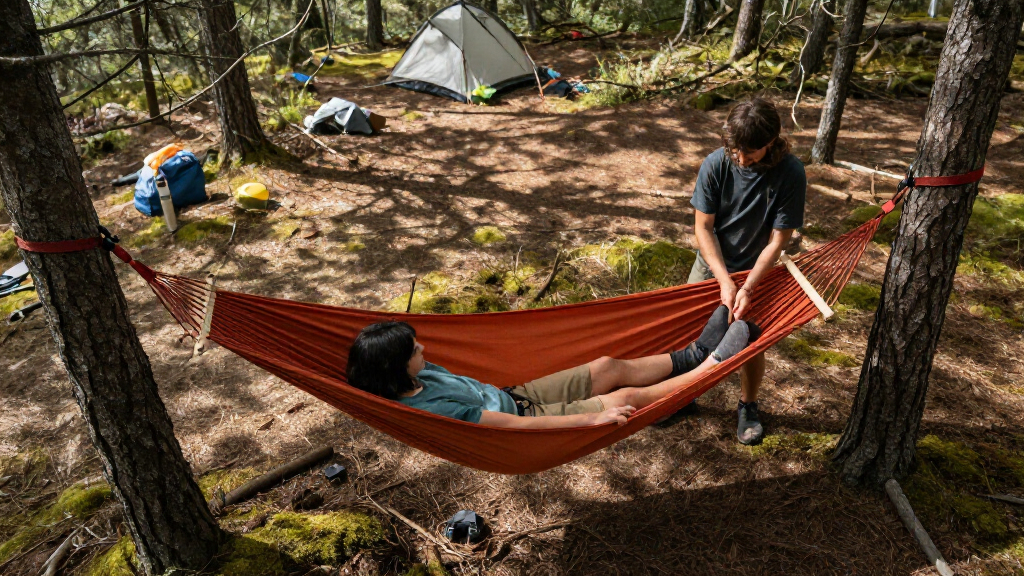
Set up a portable camping hammock between two suitable supports, check the hang, use it comfortably, and pack it away without damaging the straps or fabric. This guide is for first-time hammock campers and anyone using a new hammock system. Allow 15-30 minutes for setup and a careful check; choosing a campsite may take longer.

Get travel and outdoor gear delivered free with Prime
- Fast, free delivery on millions of items
- Prime Video, Amazon Music and more included
- Member-only deals all year

Wise Owl Outfitters Camping Hammock with Tree Straps
- ✔ Material: Quick-dry parachute nylon
- ✔ Dimensions: 10 ft x 6.5 ft
- ✔ Weight capacity: Up to 500 lbs
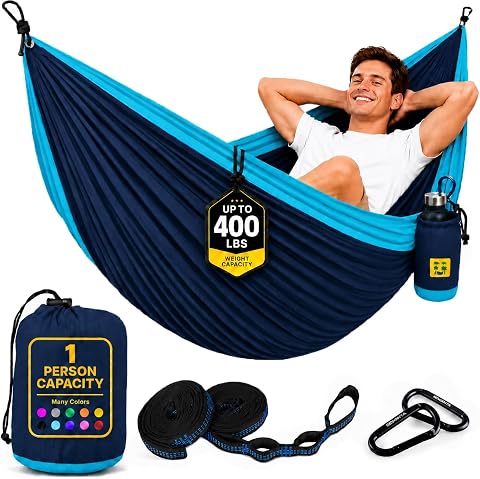
SEWANTA Nylon Camping Hammock with Tree Straps, Blue & Light Blue
- ✔ Material: Nylon
- ✔ Sizes: Single and double
- ✔ Single capacity: 400 lbs
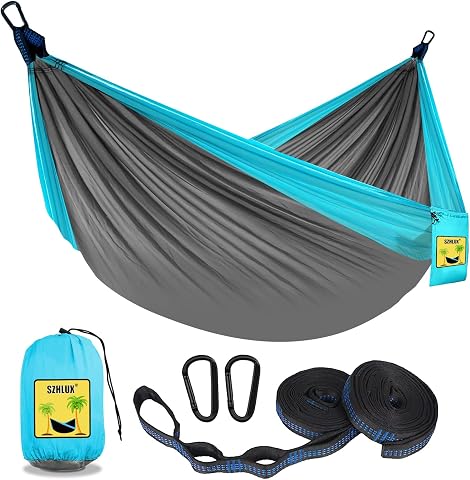
SZHLUX Portable Double Camping Hammock with Tree Straps, Carry Bag, Light Grey and Sky Blue
- ✔ Material: 210T parachute fabric
- ✔ Unfolded dimensions: 106.3 x 55.1 inches
- ✔ Packed dimensions: 6.2 x 4.7 x 3 inches
Difficulty: Beginner | Time: 15-30 minutes
What You’ll Need
Tools & Materials:
- Portable hammock with its stuff sack
- Two compatible suspension straps or the manufacturer-approved hanging system
- Two sturdy trees or approved structural anchors
- Optional: tarp, bug net, and ridgeline if your hammock system supports them
Knowledge:
- Basic ability to inspect straps, fabric, and attachment points
- Ability to identify sturdy supports and avoid dead, damaged, or unstable trees
Read the hammock and suspension instructions before use. Check the rated weight limit for the complete system, including the hammock, straps, and any added gear. Follow campsite rules about hanging equipment and tree protection. Do not hang from branches, rocks, vehicles, or structures unless the equipment maker and site rules explicitly allow that use.
Wise Owl Outfitters Camping Hammock with Tree Straps
The Wise Owl Outfitters double is our strongest all-around choice when a portable hammock needs to serve as more than a solo lounge. At 10 feet by 6.5 feet, it offers the clearest stated space for two people in this lineup, and its 500-pound capacity matches the higher limit listed for SEWANTA’s double configuration. Its 24-ounce weight remains easy to compare with the lighter SEWANTA at 1.5 pounds, though it is not the lightest choice here.Setup gear is included: two 9-foot tree straps and two aluminum carabiners, plus a built-in stuff sack. Compared with SZHLUX, those straps are shorter and the supplied details do not specify a large number of adjustment loops. The tradeoff is a more clearly defined roomy double format, with triple-stitched seams and quick-dry parachute nylon specified. We should still plan for suitable hanging points, and air-dry it after washing; no stand is included.
Pros:
- Roomy 10 ft by 6.5 ft double-size dimensions
- Stated capacity up to 500 lbs
- Includes two 9 ft straps and two aluminum carabiners
- Built-in stuff sack and machine-washable care instructions
Cons:
- At 24 oz, it is heavier than SEWANTA’s listed 1.5 lb option
- Requires suitable trees or another secure hanging point; no stand is included
- Air-drying is recommended after washing
Best for: Campers who want a roomy double hammock with a stated 500-pound capacity and a complete strap-and-carabiner kit.
Not ideal for: Solo backpackers who put the lowest listed carry weight first, or campers who need a freestanding hammock stand.
Bottom line: We rank Wise Owl first for campers who want a clearly sized double, a 500-pound stated capacity and the core hardware in one portable kit.
“We rank Wise Owl first for campers who want a clearly sized double, a 500-pound stated capacity and the core hardware in one portable kit.”
SEWANTA Nylon Camping Hammock with Tree Straps, Blue & Light Blue
SEWANTA is the carry-conscious pick: its listed 1.5-pound weight is the lowest of these three, and its folded size is 6 by 3 inches. That combination makes it appealing when we are trying to keep a camp kit small. The attached pouch adds a practical touch by doubling as a place for a phone or drink bottle, something neither other product description specifically promises.The sizing detail needs attention before we choose: SEWANTA is sold in single and double sizes. The single is listed at 400 pounds, while the double reaches 500 pounds; the listing also gives a seating capacity of one. Compared with Wise Owl’s explicitly described 10-by-6.5-foot double, the supplied SEWANTA details do not specify unfolded dimensions, so we should verify the selected variant’s fit. Two 9-foot straps with five loops each and steel carabiners are included. Instructions recommend testing strength before use, and we should follow the manufacturer’s setup guidance rather than infer suitability from capacity alone.
Pros:
- Lowest listed weight in this comparison at 1.5 lbs
- Compact stated folded size of 6 x 3 inches
- Attached pouch can hold a phone or drink bottle
- Includes two 9 ft straps and two steel carabiners
Cons:
- The single version is listed at 400 lbs; double size is needed for the stated 500 lb capacity
- Unfolded dimensions are not provided in the supplied specifications
- Instructions recommend testing strength before use
Best for: Solo campers who prioritize a low listed weight, compact folded size and a pouch that can hold small essentials.
Not ideal for: Buyers who need a clearly specified roomy double without checking the selected size, or who want more strap adjustment loops than the five per strap listed here.
Bottom line: We recommend SEWANTA when compact solo carry matters most, provided we confirm the chosen size and its capacity before heading out.
“We recommend SEWANTA when compact solo carry matters most, provided we confirm the chosen size and its capacity before heading out.”
SZHLUX Portable Double Camping Hammock with Tree Straps, Carry Bag, Light Grey and Sky Blue
SZHLUX makes the most sense when campsite setup flexibility is our priority. Its two 10-foot straps are longer than the 9-foot straps supplied with Wise Owl and SEWANTA, and each has 18 adjustment loops plus an additional loop. That extra reach and choice can help us tune the hang across a wider range of available attachment points, although no strap length removes the need for suitable, secure supports.The hammock uses 210T parachute fabric, measures 106.3 by 55.1 inches and weighs 1.8 pounds. It is described as a double with a 400-pound maximum, which is lower than the 500-pound capacities listed for the Wise Owl double and SEWANTA’s double version. That is the key compromise: SZHLUX gives us a generous number of strap adjustment points, but its listed load limit is lower. The attached carry bag, carabiners and ropes make it a complete portable kit; its stated packed dimensions, however, are larger than SEWANTA’s folded size, so it is less compelling for the tightest packing needs.
Pros:
- Two 10 ft straps offer more reach than the 9 ft straps in the other kits
- 18+1 loops per strap provide many adjustment positions
- Includes carry bag, two ropes and two carabiners
- Attached bag keeps the hammock together for transport
Cons:
- 400 lb maximum is below the 500 lb double capacities listed for Wise Owl and SEWANTA
- Listed packed dimensions are larger than SEWANTA’s folded size
- No stand is included; suitable hanging points are required
Best for: Campers who value longer straps and many adjustment loops for tuning the hang at different campsite attachment points.
Not ideal for: Buyers who need a stated 500-pound double capacity or who want the smallest listed folded package.
Bottom line: We choose SZHLUX when strap reach and adjustment options matter more than the higher stated capacity or smallest packed size.
“We choose SZHLUX when strap reach and adjustment options matter more than the higher stated capacity or smallest packed size.”
As an Amazon Associate we earn from qualifying purchases.
Before You Start
Choose a site with two stable supports spaced within the range allowed by your suspension system. Look up for dead branches, loose limbs, and other falling hazards, and look down for rocks, roots, water, or sharp objects. Leave enough room to hang without blocking a trail, fire ring, or neighboring campsite. Use wide tree straps where permitted; never wrap thin cord directly around a tree trunk, since it can cut into the bark. If weather may change, plan for a suitable tarp and check that it can be pitched without creating a hazard.
Step-by-Step Instructions
Step 1: Inspect the hammock and suspension
Unpack the hammock and lay it on a clean surface. Check the fabric for tears, the seams and end loops for loose stitching, and each strap or connector for cuts, fraying, deformation, or damage. Match the components to the manufacturer’s instructions and confirm the system’s load limit before hanging it.
Tip: Do not use a damaged strap, improvised connector, or component with an unknown rating.
Check: The fabric, seams, loops, straps, and connectors show no damage, and you know the system’s stated load limit.
Step 2: Choose a clear, suitable site
Find two permitted, sturdy supports at a distance your straps can span. Inspect the trunks or anchors and the area above and beneath the planned hang. Move away from dead branches, unstable ground, water edges, fire, and paths. Make sure the hammock can hang without touching the ground or surrounding objects.
Tip: If either support looks cracked, dead, loose, or too small for the load, select another site.
Check: The supports are stable, the ground beneath the hammock is clear, and the setup does not obstruct other campers or campsite features.
Step 3: Attach the straps to the supports
Wrap each approved strap around a support at a height suited to the distance between supports and the hammock instructions. Keep the strap broad and flat against the support, then fasten it using the specified loop or buckle. Connect the hammock to the straps with the supplied hardware or approved knots.
Tip: Use tree-friendly straps and follow local rules. Do not substitute narrow cord or tighten hardware beyond its instructions.
Check: Both straps lie flat, each connection is fully seated, and neither strap can slide down the support when gently checked.
Step 4: Set the hammock hang
Adjust the straps so the empty hammock forms a relaxed curve rather than a tight, straight line. Keep the hammock low enough for a controlled step-in and high enough to remain clear of the ground once occupied. Check that both ends sit at compatible heights and that the hammock is centered between the supports.
Tip: A very tight hang can increase force on the supports and suspension. Use the curve and setup guidance in your hammock’s instructions.
Check: The unloaded hammock has a visible curve, sits evenly, and stays clear of the ground with room for a safe entry.
Step 5: Test the setup before settling in
Stand beside the hammock and inspect every connection again. Press down gently on the center with your hands, then gradually transfer a small amount of weight while keeping your feet ready to support you. If anything slips, creaks unusually, shifts, or looks strained, step away and adjust or choose another site.
Tip: Keep your face and body clear of the suspension while checking it. Do not bounce or drop into the hammock to test it.
Check: The straps and connectors remain in place during a gradual, controlled load check, and the hammock does not touch the ground.
Step 6: Get in and lie down safely
Stand facing the hammock, hold its edge for balance, and sit in the middle rather than at one end. Then turn your legs into the hammock and lower yourself gradually. To lie flatter, shift your body diagonally across the fabric instead of lining up exactly with the hammock’s length. Keep your weight within the system’s limit.
Tip: Avoid standing in the hammock, jumping into it, or letting several people climb in unless the system is rated for that use.
Check: You are supported without touching the ground, the hammock feels stable, and the fabric and suspension show no signs of slipping or strain.
Step 7: Add weather or insect protection if needed
If your setup includes a compatible bug net or tarp, attach it according to its instructions after the hammock is secure. Arrange the tarp to cover the hammock while leaving appropriate airflow, and tension its lines away from walkways and tripping routes. Check the forecast and campsite rules before relying on the setup for overnight shelter.
Tip: A hammock alone may not protect you from rain, wind, or insects. Use suitable gear and do not block ventilation with a cover.
Check: Any added protection is firmly attached, covers the intended area, and does not interfere with safe entry, exit, or airflow.
Step 8: Exit and take the hammock down
Turn toward the edge, sit up, and place your feet on the ground before standing. Remove gear, then detach the hammock and straps in the order given by the manufacturer. Check the supports and ground for dropped items, and leave the area as you found it.
Tip: Keep connectors controlled as you release them so they do not snap back or fall into mud or water.
Check: You can exit without falling, the hammock and suspension are detached without damage, and the campsite is clear of your equipment.
Step 9: Dry, inspect, and pack the system
Shake out dirt and let wet fabric and straps dry fully before long-term storage. Inspect them again for wear after use. Pack the dry hammock and suspension in the supplied sack, keeping sharp or dirty items separate from the fabric.
Tip: Storing damp fabric can lead to mildew and unpleasant odors. If you must pack it wet during a trip, unpack and dry it as soon as practical.
Check: The system is clean enough for storage, damage has been noted, and damp components are set aside to dry rather than sealed away for long periods.
Common Mistakes to Avoid
- Hanging the hammock too tightly. — Leave a relaxed curve and follow the manufacturer’s setup guidance; a taut hang can strain the suspension and supports.
- Using narrow cord or unsuitable straps around a tree. — Use broad, approved straps where allowed, lay them flat, and follow site rules that protect trees.
- Skipping the inspection and load check. — Inspect all fabric, stitching, straps, and connectors before every use, then test the setup gradually.
- Packing the hammock away while damp. — Dry the fabric and straps before long-term storage; air them out promptly if they were packed wet during travel.
Troubleshooting
Problem: The hammock touches the ground when you sit in it.
Solution: Exit carefully, then adjust the strap height or hammock position within the manufacturer’s limits. Recheck the curve and ground clearance before using it again.
Problem: A strap slides down the support or a connector shifts.
Solution: Get out and unload the hammock. Reattach the strap flat and secure it using the specified method. Replace damaged or incompatible parts; move to a different approved support if the problem continues.
Problem: The hammock feels unstable when you get in.
Solution: Step out and check that it is centered, both ends are connected correctly, and the supports are stable. Enter more slowly from the middle. Stop using the site if a support moves or the system appears strained.
Problem: Rain or insects reach the hammock.
Solution: Check that the tarp or bug net is compatible, correctly positioned, and fully secured. Choose a more sheltered site or use appropriate protection; do not rely on the hammock fabric alone for weather protection.
What Success Looks Like
The hammock hangs in a relaxed curve between stable, permitted supports. Its straps and connectors stay in place during a gradual load check, the hammock remains clear of the ground when occupied, and entry and exit feel controlled. Any tarp or bug net is secured without blocking airflow or creating a trip hazard. After use, the gear is undamaged, the site is tidy, and damp fabric is drying before storage.
Next Steps
After your first setup, practice packing and rehanging the hammock in a safe area so the process is familiar at camp. Before the next trip, check the forecast, confirm local hanging rules, and inspect the full system. Replace worn components with compatible rated parts, and store the hammock dry in its sack.
Frequently Asked Questions
How far apart should the supports be?
Use the spacing range given by the hammock and suspension maker. Strap length, hammock design, and support height all affect the fit, so there is no single distance that works for every model.
How high should I hang a camping hammock?
Set the straps so the hammock has a relaxed curve and remains safely above the ground when occupied. The correct height depends on the support spacing and system instructions; test gradually before settling in.
Can I use any rope or straps?
No. Use suspension components made for your hammock or approved by its manufacturer, with a clear load rating. Avoid thin cord, damaged straps, and improvised connectors.
Can I sleep in a hammock without a tarp?
You can use a hammock without a tarp in suitable dry conditions, but the hammock itself may not shield you from rain or wind. Check the forecast and bring compatible shelter when conditions call for it.
How should I store a hammock after a wet trip?
Unpack it as soon as practical and let the fabric and straps dry completely before long-term storage. Brush off dirt and check for damage before packing it away.
Evergreen bestsellers Picks

Samsung 55-Inch S90H OLED 4K UHD Smart TV Bundle with Full-Motion Mount and Surge Protector

Ninja Prestige Smart XL 10-in-1 Air Fryer and Countertop Oven with Pro Cook System, Stainless Steel, DT551

Roborock Q7 M5+ Robot Vacuum and Mop with Self-Emptying Dock
As an affiliate, we earn on qualifying purchases.