
TL;DR

Get travel and outdoor gear delivered free with Prime
- Fast, free delivery on millions of items
- Prime Video, Amazon Music and more included
- Member-only deals all year
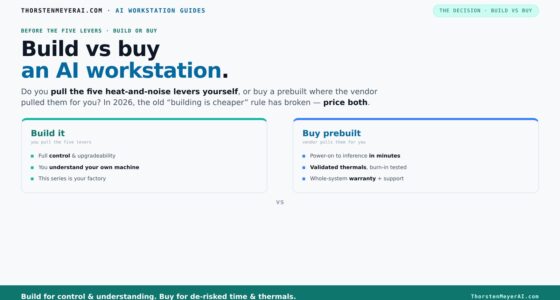
Thorsten Meyer AI has published a counterargument to its recent support for sovereign AI, saying most organizations may gain more from the strongest available model and a multi-provider routing layer. It maintains that sovereign systems remain warranted for legally restricted, classified, health and regulated financial workloads, while many supporting figures await independent verification.
Thorsten Meyer AI has challenged its own recent advocacy for sovereign AI infrastructure, arguing that most organizations should use the most effective available model unless law, classified data or binding regulation prevents it. The July 16 analysis matters because it recasts sovereignty as a costly safeguard for a limited group rather than a default requirement for every AI buyer.
The publication said its previous eight analyses repeatedly favored owning models and infrastructure rather than relying on an external API. Its new argument says that pattern risked becoming a fixed thesis, with evidence interpreted through the same frame. The resulting review divides buyers into two groups: organizations that are legally bound to sovereign deployment and those making a voluntary risk-management choice.
For the second group, the dispatch argues that model capability, deployment speed and operating cost should carry more weight. It cites self-reported benchmark results showing Inkling at 77.6% on SWE-bench against 95.0% for Fable 5, and 63.8% against 89.5% on Terminal-Bench. The publication acknowledges that the figures come from vendor tables and Artificial Analysis data and are awaiting independent replication.
The dispatch also says a Commerce directive removed access to Fable 5 and Mythos 5 from June 12 to July 1, describing the disruption as an 18-day service degradation during which alternative models remained available. That account was presented as evidence that many companies can address provider risk with a routing layer and business-continuity planning. The supplied source material does not include the directive or independent confirmation of the dates, scope or affected customers.
Performance Gains Versus Control Costs
The argument could affect how technology leaders allocate AI budgets. A company choosing weaker models for broad sovereignty goals may accept lower task-completion rates, slower product releases and added infrastructure costs. According to the dispatch, that performance gap can accumulate across repeated software, research and operational tasks, making opportunity cost part of the purchasing decision.
The distinction is also relevant to European technology policy. The publication argues that demand from companies without a binding legal need can encourage sovereignty labels and ownership structures instead of systems built for customers handling classified or tightly regulated data. That is the author’s interpretation, not a finding established by the cited market figures.
AI model performance benchmarking tools
As an affiliate, we earn on qualifying purchases.
As an affiliate, we earn on qualifying purchases.
Five Weeks of Sovereignty Advocacy
Before this dispatch, Thorsten Meyer AI had spent five weeks arguing that buyers should examine model ownership, hardware capacity, shareholder control and the risk that an outside provider could withdraw service. Its reporting covered European model developers, cloud operators, ownership rules and the exposure of customers in jurisdictions including the Five Eyes countries.
The new analysis does not abandon that earlier work. Instead, it narrows the proposed use case for full sovereignty to defence, classified workloads, national health data and finance subject to rules such as DORA. For those deployments, the publication says foreign legal control can become a legal barrier, leaving buyers unable to substitute a higher-scoring external model.
“For almost everyone, sovereignty is an expensive hedge against a risk they have mispriced.”
— Thorsten Meyer AI, July 16 dispatch
multi-provider AI routing layer software
As an affiliate, we earn on qualifying purchases.
As an affiliate, we earn on qualifying purchases.
Benchmark and Outage Evidence Unverified
Several central figures remain uncertain. The benchmark scores are described as self-reported and awaiting replication, while the claimed costs of SecNumCloud qualification, dedicated staff and idle computing capacity are drawn from earlier reporting rather than documentation reproduced in the source material. The claim that routing provides 90% of resilience for about 2% of the cost is also presented without a disclosed calculation.
It is not yet clear how many organizations were affected by the reported 18-day model withdrawal, what workloads failed or whether substitutes delivered comparable results. The analysis also does not establish a universal boundary between legally required sovereignty and voluntary preference; that boundary varies by jurisdiction, contract, data type and regulator.
enterprise AI deployment infrastructure
As an affiliate, we earn on qualifying purchases.
As an affiliate, we earn on qualifying purchases.
CTOs Face a Binding Test
The publication urges technology leaders to determine whether their organizations are legally bound or voluntarily seeking additional control. Companies in the latter group are advised to compare leading models, place a multi-provider router in front of them and maintain tested fallback plans before funding dedicated clusters or qualification programs.
Regulated organizations will need to document which laws, contracts and data classifications restrict deployment, then compare sovereign providers on security, capability and total cost. Independent replication of the cited benchmarks and fuller evidence about the June service restriction would help test whether the publication’s revised position holds across real deployments.
AI model performance evaluation kit
As an affiliate, we earn on qualifying purchases.
As an affiliate, we earn on qualifying purchases.
Key Questions
Has Thorsten Meyer AI stopped supporting sovereign AI?
No. It now supports sovereign deployment for legally restricted workloads, including classified, defence, national health and some regulated financial uses. Its revised argument opposes treating full infrastructure ownership as the default for every organization.
What does using the best model mean here?
It means selecting the model that produces the strongest results for a defined workload, based on tested capability, reliability and cost. The dispatch argues that buyers should not accept a weaker model solely for a broad sovereignty preference.
What is the proposed alternative to owning the full AI stack?
The publication proposes a routing layer connected to multiple providers, supported by tested business-continuity procedures. That design may reduce dependence on one vendor, although the claimed cost and resilience benefits have not been independently established here.
Are the performance and cost figures confirmed?
Not independently. The source identifies the model benchmarks as self-reported and awaiting replication, while several infrastructure estimates come from earlier reporting and industry sources. Buyers would need their own workload tests and documented cost comparisons.
Which organizations may still need sovereign systems?
Organizations handling classified information, defence work, national health records or financial data subject to strict localization and operational-resilience rules may face binding limits. The exact requirement depends on applicable law, contracts and regulatory guidance.
Source: Thorsten Meyer AI
Halloween Picks
halloween
As an affiliate, we earn on qualifying purchases.