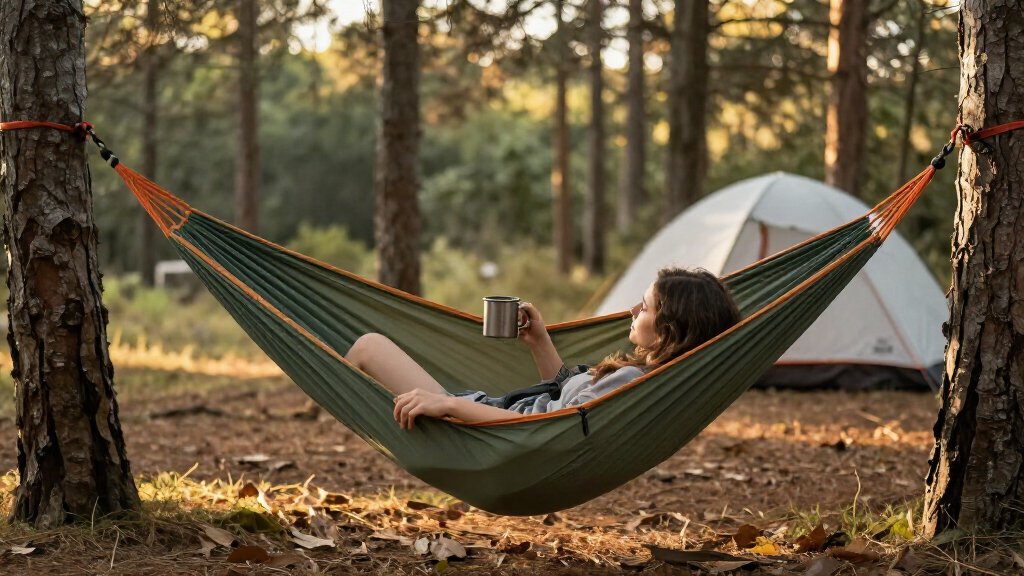

Set up a portable camping hammock between two suitable supports, adjust it for a comfortable lay, and pack it away after your stay. This guide is for first-time hammock campers and anyone who wants a repeatable setup routine. Allow 15-30 minutes for your first setup; later setups usually take less time.

Get travel and outdoor gear delivered free with Prime
- Fast, free delivery on millions of items
- Prime Video, Amazon Music and more included
- Member-only deals all year

Wise Owl Outfitters Single Camping Hammock, Black and Grey
- ✔ Capacity: 1 person
- ✔ Dimensions: 9 ft x 4.5 ft
- ✔ Weight: 16 oz
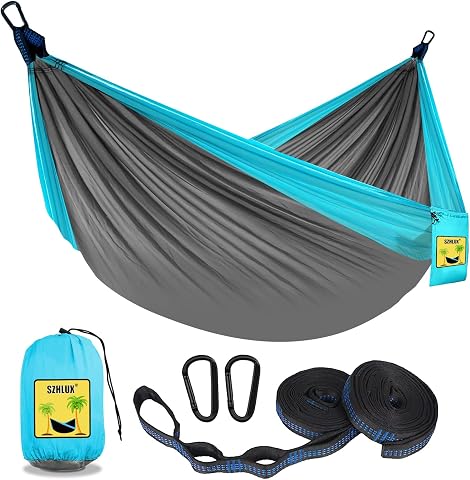
SZHLUX Double Camping Hammock with Tree Straps and Carry Bag, Light Grey and Sky Blue
- ✔ Capacity: 2 people
- ✔ Unfolded dimensions: 106.3 x 55.1 in
- ✔ Folded dimensions: 6.2 x 4.7 x 3 in
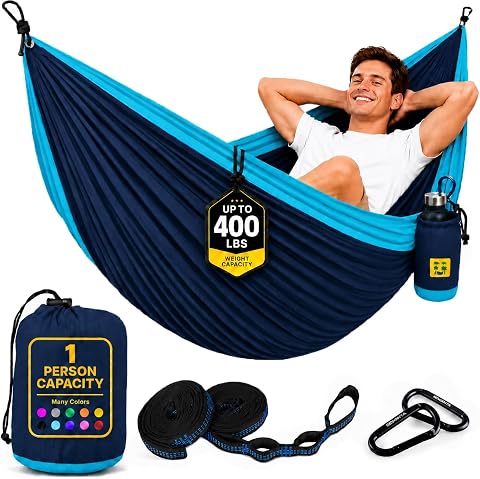
SEWANTA Portable Nylon Camping Hammock with Tree Straps, Blue and Light Blue
- ✔ Material: Nylon
- ✔ Weight: 1.5 lbs
- ✔ Folded size: 6 x 3 in
Difficulty: Beginner | Time: 15-30 minutes
What You’ll Need
Tools & Materials:
- Portable hammock with suspension straps or approved hanging system
- Two suitable trees or manufacturer-approved supports
- Tree-friendly straps wide enough to protect bark
- Rain tarp and bug net if conditions call for them
- Sleeping pad or underquilt for cool weather
- Headlamp for setting up near dusk
Knowledge:
- Basic ability to inspect straps and knots or buckles
- Ability to read the hammock and suspension weight limits
Check the hammock maker’s instructions before setup. Use the lowest weight rating among the hammock, straps, carabiners, and other suspension parts as your limit. Choose wide tree straps and follow local rules; some parks prohibit hammocks or require specific strap widths.
Wise Owl Outfitters Single Camping Hammock, Black and Grey
For campers carrying their sleep or rest kit over distance, 16 ounces is the standout figure in this lineup. The Wise Owl is a single hammock measuring 9 by 4.5 feet, and its included straps, D-shaped aluminum carabiners, and stuff sack mean the basic hanging kit travels together. Compared with the wider SZHLUX double, this pick gives up shared space in exchange for a lower listed weight and a simpler solo fit.Its triple-stitched seams and quick-dry parachute nylon make it a sensible all-around choice for outdoor use. The hammock body is also listed as machine washable on a gentle, cold cycle, with air-drying recommended. That care requirement is manageable, though it means packing a damp hammock for the next leg is not ideal. The 400-pound capacity is substantial for a single, but the hammock still requires two suitable anchor points, such as trees or a porch beam.We rank it first because its weight, single-person dimensions, and included components make its camping role particularly clear. SEWANTA offers an attached pouch with more day-to-day utility, and SZHLUX provides more width, but neither has a lower stated weight. Choose Wise Owl for a compact solo setup; skip it if you want room to share or prefer a hammock with a built-in pocket.
Pros:
- At 16 ounces, it is the lightest option listed.
- Includes two 9-foot tree straps, aluminum carabiners, and a drawstring carry bag.
- Triple-stitched seams and quick-dry parachute nylon suit regular outdoor use.
- Hammock body can be machine washed on a gentle, cold cycle.
Cons:
- Designed for one person, so it does not offer SZHLUX’s wider double layout.
- The body should be air-dried, which can slow packing after wet use.
- Requires two suitable anchor points.
Best for: Solo campers and backpackers who want the lightest listed hammock with its straps and carabiners included.
Not ideal for: Two-person use, campers who need a freestanding setup, or anyone who wants an attached storage pocket.
Bottom line: We recommend Wise Owl Outfitters for solo campers who put low carry weight and a complete hanging kit ahead of extra room.
“We recommend Wise Owl Outfitters for solo campers who put low carry weight and a complete hanging kit ahead of extra room.”
SZHLUX Double Camping Hammock with Tree Straps and Carry Bag, Light Grey and Sky Blue
The SZHLUX is the widest option with a clearly stated unfolded width: 55.1 inches, alongside a length of 106.3 inches. That makes it more accommodating than either single hammock for spreading out or occasional shared use. Its 210T parachute fabric is described as tear-resistant, quick-drying, and easy to clean, while the attached storage bag keeps the hammock compact when it is time to move camp.Its strongest camping advantage is the included suspension: two 10-foot straps with 18+1 adjustment loops each allow height changes without tying knots. That is more adjustment points than SEWANTA’s five loops per strap. The tradeoff is a listed 1.8-pound weight, above both solo options, and the 400-pound maximum capacity is lower than SEWANTA’s stated double-size capacity. The width may invite two-person use, but the load limit and dimensions deserve attention: adults seeking generous room may find this bed close.Compared with Wise Owl, SZHLUX makes room the priority rather than minimal pack weight. Compared with SEWANTA, it supplies longer straps and more loops, though at a heavier listed carry weight. We place it second because these are meaningful strengths for campsite flexibility, balanced by a load limit and double fit that call for a careful check. Pick it when adjustability and width matter more than ounces.
Pros:
- Widest stated hammock body in the lineup at 55.1 inches.
- Two 10-foot straps offer 18+1 loops each for knot-free adjustment.
- Attached storage bag keeps the hammock together for transport.
- Fabric is described as quick-drying and easy to clean.
Cons:
- At 1.8 pounds, it is heavier than both single-hammock options.
- Its 400-pound capacity is lower than SEWANTA’s stated double-size limit.
- Listed dimensions may feel crowded for two adults.
Best for: Campers who want a wider hammock and more strap adjustment points for varied campsite anchor heights.
Not ideal for: Weight-focused backpackers, two adults who need a roomy bed, or buyers whose combined load could exceed 400 pounds.
Bottom line: We favor SZHLUX for campers who value a wider bed and highly adjustable straps and can accept its weight and 400-pound limit.
“We favor SZHLUX for campers who value a wider bed and highly adjustable straps and can accept its weight and 400-pound limit.”
SEWANTA Portable Nylon Camping Hammock with Tree Straps, Blue and Light Blue
SEWANTA differentiates itself through a small but useful campsite detail: its attached pouch can hold a phone or drink bottle when the hammock is in use. That keeps essentials within reach without adding a separate organizer. At 1.5 pounds with a stated folded size of 6 by 3 inches, it is still compact, although Wise Owl’s 16-ounce weight makes that model the stronger choice when every ounce counts.The kit includes two 9-foot straps with five adjustable loops each and two steel carabiners. This provides a straightforward setup package, but fewer listed adjustment points than SZHLUX’s 18+1 loops per strap. SEWANTA’s capacity varies by size: the single supports 400 pounds and the double supports 500 pounds. The supplied specs also describe the seating capacity as one and provide dimensions as 10 x 15 inches, figures that do not give a clear full hammock footprint. We would confirm the chosen size and full dimensions before relying on it for a particular sleeping position.Against Wise Owl, SEWANTA offers the pouch and a slightly heavier carry. Against SZHLUX, it has a higher stated double capacity but less strap adjustment and less clearly specified fit information. We rank it third because the convenience feature is appealing, while the ambiguous dimensions make it harder to judge fit than the other two. Choose it for pocket convenience after confirming the size; skip it if you need well-documented sleeping dimensions.
Pros:
- Attached pouch can hold a phone or drink bottle while the hammock is in use.
- Compact stated folded dimensions of 6 x 3 inches.
- Includes two 9-foot straps with adjustable loops and steel carabiners.
- Double size is listed with a 500-pound capacity.
Cons:
- At 1.5 pounds, it weighs more than Wise Owl’s 16-ounce single hammock.
- Only five adjustable loops per strap, fewer than SZHLUX’s listed loop count.
- Provided dimensions of 10 x 15 inches do not clarify the full hammock footprint.
Best for: Campers who want an attached pocket for small essentials and value a compact pack over the lowest possible weight.
Not ideal for: Buyers who need clear, full-size dimensions before purchase or want the most strap adjustment points.
Bottom line: We recommend SEWANTA when an attached pocket matters and the buyer can confirm the selected size’s full dimensions.
“We recommend SEWANTA when an attached pocket matters and the buyer can confirm the selected size’s full dimensions.”
As an Amazon Associate we earn from qualifying purchases.
Before You Start
Pick a site where hammock use is permitted. Look for two living, sturdy trees with no dead branches overhead, unstable ground, or nearby hazards. Do not hang from damaged trees, light poles, railings, or supports that are not rated for the load. Keep the hammock low enough that a fall would be minor, and avoid placing it over water, rocks, fire rings, or sharp objects. If rain or cold is possible, plan for a tarp and insulation before you hang the hammock.
Step-by-Step Instructions
Step 1: Choose a safe pair of supports
Walk the campsite and select two sturdy, healthy trees spaced within the reach of your suspension system. Check above and around each tree for dead limbs, loose branches, ant nests, and hazards. Clear sticks and stones from the ground beneath the hammock, then confirm that the site allows hammock use.
Tip:Do not force a setup across trees that are too far apart by using an extreme strap angle or nonapproved extensions.
Check: Both supports are stable, the ground below is clear, and the hammock can hang without stretching the suspension to its limit.
Step 2: Attach the straps at a safe height
Wrap a wide tree strap around each trunk at roughly head height or lower. Thread the strap through its approved loop or buckle as directed by the maker. Keep the strap flat against the bark, without twists, and do not use thin cord directly on a tree.
Tip:Wide straps spread the load and reduce bark damage. Follow park rules if they specify a minimum strap width.
Check: Each strap sits flat, stays in place when lightly tugged, and does not cut into or scrape the trunk.
Step 3: Connect the hammock
Clip or loop each hammock end onto its strap using only the supplied or manufacturer-approved connection. Close every carabiner gate fully, and check that each connection rests correctly in the strap loop or buckle. Keep the hammock centered between the trees.
Tip:Do not substitute hardware-store hooks or improvised knots unless the hammock maker approves them for suspension.
Check: The hammock is attached at both ends, all buckles or gates are closed, and the fabric hangs freely without touching the ground.
Step 4: Set a relaxed hanging curve
Adjust the straps so the hammock hangs with a noticeable curve rather than pulled tight like a line. As a starting point, aim for suspension straps that rise from the hammock at about a 30-degree angle. Keep the hammock seat low, around chair height or lower, so entering and exiting are manageable.
Tip:A very tight hang increases force on the suspension and can feel uncomfortable. Make small adjustments instead of tightening one side dramatically.
Check: The hammock has a gentle sag, both ends sit at a similar height, and the center remains safely above the cleared ground.
Step 5: Test the setup before settling in
Stand beside the hammock and press down on its center with your hands. If the straps slip, the hammock shifts sharply, or any part creaks or deforms, get out of the loading position and inspect the setup. When it feels stable, sit in the middle slowly, keeping one hand on a strap or the hammock edge. Swing your legs in only after the fabric supports you.
Tip:Do not jump into the hammock or let children play by bouncing in it. Sudden loading can damage the fabric or suspension.
Check: The hammock supports your weight without strap movement, hardware opening, fabric damage, or contact with the ground.
Step 6: Adjust your position and comfort
Lie diagonally across the hammock rather than straight down its center. Shift your shoulders and feet slightly apart until the fabric supports your body more evenly. Add a sleeping pad or underquilt beneath you when the air is cool, since wind can chill the underside even when the top feels warm.
Tip:For overnight use, check that your head and feet are supported and that you can get out easily. Keep a flashlight within reach.
Check: You can lie comfortably without feeling tightly folded, and you have the insulation needed for the expected temperature.
Step 7: Add weather and insect protection
Hang a rain tarp above the hammock when rain, wind, or dew is expected. Position it so water runs away from the hammock and the sides provide suitable coverage. Attach a bug net according to its instructions, checking that it closes fully and does not press tightly against your face.
Tip:Leave airflow around the hammock. Do not use a stove, candle, or open flame beneath a tarp or near hammock fabric.
Check: The tarp sheds water away from the sleeping area, and the bug net closes without gaps.
Step 8: Take down and pack the hammock
Remove the tarp and bug net first, then step out and detach the hammock. Unwrap the straps without dragging them across the bark. Shake dirt and leaves from each item, let wet gear dry when practical, and pack the components in their storage bags.
Tip:Before leaving, check the site for small hardware, cord, or wrappers, and leave the trees and ground as you found them.
Check: All parts are accounted for, the supports show no damage, and the campsite is clear of your gear and litter.
Common Mistakes to Avoid
- Hanging the hammock too tightly. — Adjust for a relaxed curve and moderate strap angle; tighten only enough to keep the hammock safely off the ground.
- Using narrow cord or straps that damage bark. — Use wide, tree-friendly straps and comply with the site’s minimum width rules.
- Skipping a weight-rating check or mixing incompatible hardware. — Read each component’s rating and instructions, and use the lowest-rated component as the system limit.
- Assuming the hammock alone will keep you warm overnight. — Bring a sleeping pad or underquilt when temperatures or wind could chill the underside.
Troubleshooting
Problem: The hammock sags until it nearly touches the ground.
Solution: Shorten or raise both straps in small increments, then recheck the sag and test the setup again. Confirm the supports are close enough for the suspension.
Problem: The straps slide down the tree.
Solution: Unload the hammock, rewrap the straps according to their instructions, and confirm the buckles or loops are threaded correctly. Choose a more suitable trunk if they continue to slip.
Problem: The hammock feels tight or causes pressure at the shoulders.
Solution: Loosen the suspension slightly to add sag, then lie diagonally and shift your position. Check that the fabric is not twisted.
Problem: You feel cold underneath despite using a sleeping bag.
Solution: Add a sleeping pad or underquilt beneath the hammock and block wind with a properly pitched tarp while keeping ventilation open.
What Success Looks Like
Your hammock hangs in a stable curve between suitable supports, sits low enough for a controlled entry and exit, and stays clear of the ground when loaded. The straps and connections remain in place during use, the sleeping setup matches the weather, and all equipment can be removed without leaving damage or litter.
Next Steps
After the trip, dry the hammock, straps, tarp, and bug net fully before storing them to limit mildew and fabric damage. Inspect stitching, webbing, buckles, and carabiners for wear before the next outing. Replace damaged parts with compatible components, and practice the setup at home or in a permitted local area before relying on it for an overnight trip.
Frequently Asked Questions
How far apart should the trees be?
Use spacing that fits the hammock and suspension instructions. If the trees are too far apart, the straps may be forced to an unsafe angle; if they are too close, there may not be enough room for a relaxed curve.
Can I hang a camping hammock from any tree?
No. Use healthy, sturdy trees that can support the load, and check for dead limbs overhead. Follow local rules and avoid young, damaged, or protected trees.
Is a hammock safe to sleep in overnight?
It can be suitable when the hammock and suspension are used within their ratings, the supports are sound, and the setup is tested before sleep. Add insulation and weather protection suited to the forecast.
Do I need a tarp or bug net?
Use a tarp when rain, wind, or heavy dew is likely, and a bug net when insects could disturb your sleep. Both should be compatible with your hammock and pitched with adequate airflow.
How do I know the hammock is hanging at the right height?
Keep it low enough that you can sit in it and get out steadily, with the loaded center clear of the ground. A gentle sag and a moderate strap angle are useful starting points; adjust to your hammock maker’s guidance and comfort.